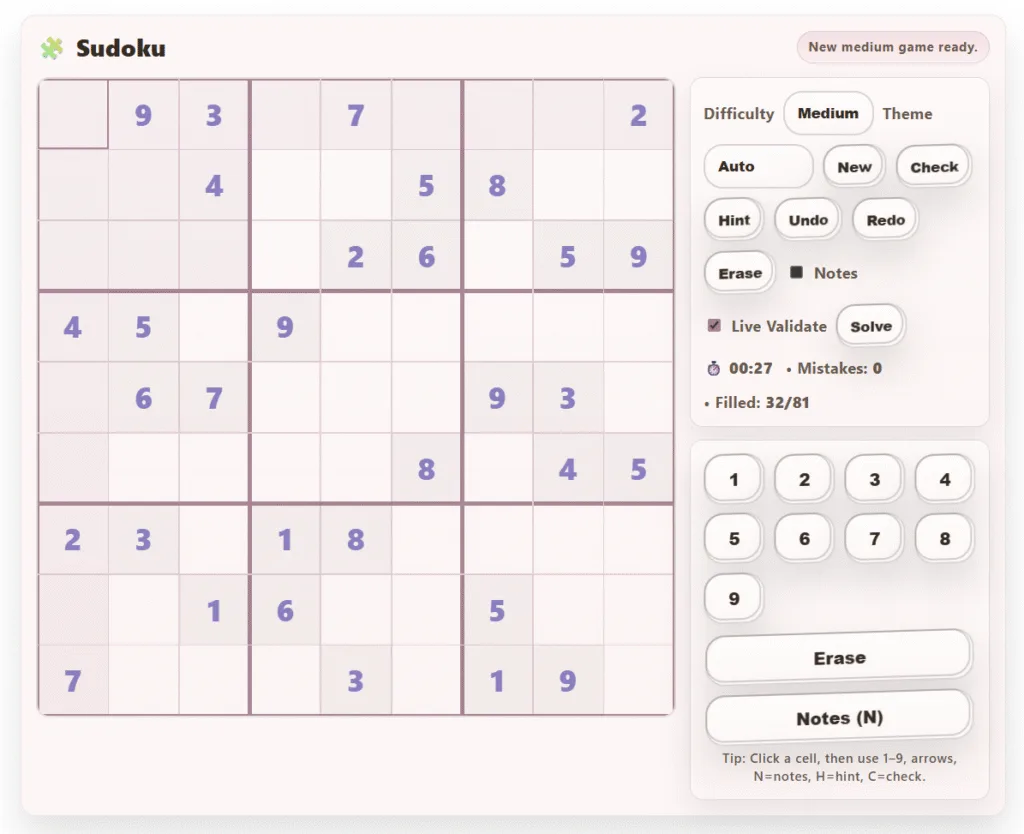
Embarking on your Logic Grid adventure can seem intimidating at first, but this easy tutorial will walk you through the fundamentals. First, understand the goal: to fill a nine-by-nine table with figures from 1 to 9. Each row, each column, and each of the groups of 3x3 regions must feature all digits exactly one time. Start by examining the grid for clear placements. After that, use deduction to remove choices in each space. With practice, you'll master filling Sudoku in no time!
Sudoku Mastery: Strategies for All Levels
Want to improve your puzzle skills ? Whether you’re a fresh player or a seasoned pro, perfecting Sudoku involves understanding several essential techniques. Start with the basics: scanning rows, columns, and blocks for obvious positions . Then, move on to more sophisticated methods Sudoku nyt like lurking numbers and apparent combinations. Don't forget to pencil possible candidates in each square – a crucial step for advanced puzzles . Here are a few helpful hints :
- Concentrate on areas with the limited starting points.
- Use the process of deduction.
- Practice regularly with different challenges .
- Explore using a Sudoku solving manual .
With dedication and frequent effort , you can unlock a new level of Sudoku expertise .
NYT Sudoku: Strategies to Tackle the Daily Grid
Conquering the New York Times Sudoku regular puzzle can be a rewarding experience, but it often requires more than just guessing. Start with the simple techniques like scanning each row, line and block for lone candidates. Pinpoint cells where a number can only realistically fit in one spot . Once those straightforward eliminations are done, progress to more sophisticated strategies. These encompass techniques such as Hidden Singles (where a number is the only possibility in a row, column or block), Naked Groups (where two or three cells share the same two or three candidates), and Swordfish Pairs/Triples to also reduce options. Consider keeping records of potential candidates in soft lead to assist your thought process. With practice , even the most difficult NYT Sudoku puzzles become solvable .
- Review rows, verticals and blocks.
- Employ Hidden Singles .
- Apply Naked Pairs .
- Take candidate markings.
Websudoku: Your Guide to Online Sudoku Play
Enjoying traditional Sudoku puzzles has never been simpler thanks to the advent of Websudoku! Online Sudoku platforms offer a superb way to improve your deduction skills everywhere and at all times. You can find a extensive selection of Websudoku sites, including varying intensity settings to accommodate fans of all skill levels . Many platforms provide useful tools such as note-taking and mistake detection, while others let you to vie against other users on scoreboards .
- Explore different Websudoku options .
- Alter the level to personal preference.
- Employ the available support tools .
Sudoku Explorations: Exploring Various Sudoku Versions
Beyond the traditional 9x9 Sudoku puzzle, a expansive realm of variants awaits the enthusiastic solver. Numerous enthusiasts are increasingly seeking fresh challenges. Consider, for example , the Samurai Sudoku, where multiple standard Sudoku grids merge to form a larger puzzle. Or delve into Killer Sudoku, which includes sum constraints within areas. For a genuine twist, try X-Sudoku Sudoku, where the usual row, column, and block rules are expanded with extra diagonal restrictions. In conclusion , the diverse landscape of Sudoku offerings ensures endless amusement and mental exercise .
- Combined Sudoku
- Killer Sudoku
- X Sudoku
Achieve Sudoku Success : From Newbie to Expert
Feeling challenged by Sudoku? Don't worry , you can transform from a struggling player into a adept solver! This resource will present the key techniques for cracking even the toughest puzzles. We’ll discuss everything from basic strategies like scanning and marking candidates, to complex methods like X-Wing and Swordfish. Get prepared to improve your logical abilities and relish the satisfaction of completing a perfectly filled Sudoku grid!
Comments on “Sudoku for Beginners: A Gradual Explanation”